Professional Perspectives: How Online NAM Platforms Are Changing Toxicity Testing
By Kinga Nimz, Karolina Jagiello, PhD and Maciej Stępnik, MD, PhD, DSc | August 20th, 2026
“For acute inhalation toxicity, the challenge is often not the lack of alternative methods, but turning available NAMs into practical, decision-support workflows.”
Traditional animal studies used to generate health safety information are expensive, time-consuming, and can raise ethical issues. At the same time, regulators need reliable hazard data to protect consumers and workers. This tension has accelerated the search for alternative approaches that can deliver reliable results more efficiently and with greater human relevance. New Approach Methodologies (NAMs) are therefore increasingly viewed as practical tools for modernizing chemical safety assessments.
Regulatory landscapes on both sides of the Atlantic reflect this transition. In the United States, the U.S. Environmental Protection Agency’s shift toward validated NAMs to reduce reliance on animal testing is supported by legislative changes, most notably the 2016 Frank R. Lautenberg Chemical Safety for the 21st Century Act, which amended the Toxic Substances Control Act (TSCA) and includes a conditional mandate aimed at the reduction of vertebrate animal testing while calling for the development of scientifically reliable alternative methods. These approaches include in vitro systems, computational toxicology, and high-throughput screening tools. Similarly, in Europe, regulators have broadened the acceptance of non-animal approaches. Under the Registration, Evaluation, Authorisation and Restriction of Chemicals (REACH) implemented by the European Chemicals Agency, data gaps may be addressed through a range of alternative methods when they are scientifically justified and transparently documented. These approaches include quantitative structure–activity relationship (QSAR) models, which predict the biological activity or toxicity of chemicals based on their molecular structure and estimate exposure risks; read-across and chemical category approaches; in vitro assays; and weight-of-evidence evaluations. Together, these developments reflect a strong push toward integrating multiple lines of evidence rather than relying on a single testing approach.
Acute inhalation toxicity typically refers to systemic adverse effects, including mortality, that occur following 4-6 hours of inhalation exposure and up to 14 days of observation. Because this endpoint reflects whole-organism outcomes, translating mechanistic or lung-specific biological responses into regulatory hazard categories remains scientifically challenging. Consequently, regulatory confidence increasingly depends on integrating different lines of evidence. Current research into NAMs therefore focuses less on replacing guideline studies, such as OECD Test Guideline 403 (an in vivo acute inhalation toxicity study in rodents designed to determine endpoints such as the median lethal concentration, LC50, following short-term exposure), and more on identifying early biological responses in respiratory tissues that can inform hazard identification and complement existing safety assessments.
A growing number of NAMs have emerged to address this need. These include human-relevant cell-based assays, advanced airway and lung tissue models, mechanistic models aligned with adverse outcome pathways, read-across approaches, and QSAR models. Although this growing toolbox offers exciting new possibilities, it has also revealed how complex accurate safety assessment can be. Rather than relying on a single method, regulatory decision-making increasingly requires strategic combinations of multiple NAMs that work together within integrated testing approaches.
To address this fragmentation, an online NAM knowledge platform has been developed. The curated infrastructure, NAMs Network, provides structured information about available methods, including their biological domain, validation context, and regulatory relevance. The platform allows users to search for methods aligned with defined endpoints, such as acute inhalation toxicity, instead of relying on scattered literature searches.
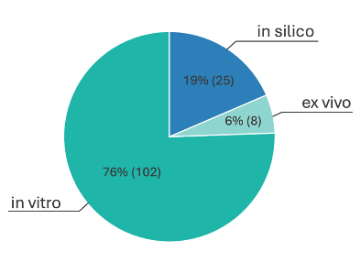
Figure 1. Distribution of NAM types for acute inhalation toxicity in the NAMs.Network database. Credit: Created by the authors based on NAMs.Network data.
For acute inhalation toxicity and related respiratory hazards, a wide range of NAMs has been included in the NAMs. Network (Figure 1). This diversity highligts both the rapid expansion of alternative methodologies and the challenge of navigating them.
Experimental approaches include advanced in vitro systems, such as air–liquid interface airway models, lung-relevant assays, and ex vivo tissues. In parallel, mechanistic frameworks structured around adverse outcome pathways help connect early molecular or cellular events with downstream toxicological outcomes. Computational approaches provide additional evidence for hazard prediction and exposure interpretation.
Each method captures specific aspects of inhalation toxicity (e.g., cellular injury or inflammation) but does not fully reproduce whole-organism responses. Their value lies in contributing complementary evidence within integrated testing strategies.
Among computational approaches, several types of models contribute to inhalation toxicity assessment, including QSAR models, read-across approaches supported by structural similarity analyses, and physiologically based kinetics (PBK) models. QSAR models are widely used in regulatory toxicology because they generate hazard predictions directly from chemical structure, enabling rapid screening and prioritization when experimental data are limited.
Moving from a published QSAR model to a regulatory-ready workflow is often cumbersome. A QSAR model for acute inhalation toxicity described in Chemical Research in Toxicology may serve as an example: while the publication outlines a descriptor-based approach, it does not constitute an operational tool. Users must reconstruct model parameters and ensure predictions remain within the intended domain, which can introduce variability and limit reproducibility.
One way to address this barrier is through integration within structured computational environments that operationalize published NAMs. By linking curated knowledge platforms to executable tools, the pathway from discovery to application becomes shorter and more consistent. Rather than rebuilding models from scratch, users can apply predefined algorithms within documented boundaries and generate standardized outputs suitable for internal assessment or regulatory documentation. Transparency remains essential: model parameters, training data, applicability domains, and uncertainty metrics must be clearly documented to avoid opaque “black box” predictions (see, e.g., regulatory emphasis on transparency and reduction of animal testing in frameworks such as those promoted by the U.S. EPA under the Lautenberg Chemical Safety Act).
For acute inhalation toxicity, where animal studies are costly, technically demanding, and ethically sensitive, such integration can accelerate progress toward non-animal safety assessment while maintaining scientific rigor. The transition from NAM discovery to application depends not only on the development of new methods, but also on systems that connect knowledge, computation, and regulatory context. By linking NAM knowledge platforms with computational tools and structured workflows, the field can move from isolated methods toward practical, decision-support systems for inhalation toxicity assessment.
Key Takeaways
The main barrier to broader NAM regulatory acceptance is integration, not innovation.
Connecting curated NAM platforms with executable tools improves efficiency, reproducibility, and defensibility.
Robust digital and methodological infrastructure can facilitate the translation of NAM development into practical regulatory and policy applications.
Future Outlook
The next phase of inhalation toxicity assessment will depend on operational readiness. As regulators continue to encourage NAM use, success will hinge on interoperable systems that translate published models into transparent, decision-support workflows. Without such integration, promising methods may remain underused in practice.
Kinga Nimz is an R&D Specialist at QSAR Lab Ltd with a background in computational toxicology and regulatory science. Her work focuses on New Approach Methodologies (NAMs), QSAR modeling, and data standardization to improve the regulatory readiness and 0000-0002-2730-6873 practical implementation of non-animal approaches in chemical safety assessment.
Senior R&D Specialist and Vice-Chair of the Scientific Council at QSAR Lab Ltd, and Assistant Professor at the University of Gdańsk. She specializes in computational (nano)toxicology, focusing on the development of machine learning models for assessing the safety of chemicals and nanomaterials. Her work centers on the development, validation, and regulatory application of AOP-anchored in silico New Approach Methodologies (NAMs).
Expert in the field of toxicology, nanotoxicology, safety assessment of nanotechnology products, assessment of health hazards from chemical substances, mechanisms of mutagenic and carcinogenic effects, and application of alternative methods in toxicology.
He is a main R&D specialist at QSAR Lab Ltd and a University Professor in the Department of Toxicology, Pharmacy Faculty, Medical University of Łódź, Poland. Member of the Scientific Committee on Consumer Safety (SCCS) in Luxembourg (Working Group on Cosmetic Ingredients, Working Group on Nanomaterials in Cosmetics, Working Group on Methodology) and the Hearing Expert in the Cross-cutting Working Group on Genotoxicity at the European Food Safety Authority (EFSA).
The views expressed do not necessarily reflect the official policy or position of Johns Hopkins University or Johns Hopkins Bloomberg School of Public Health.